This is NOT for melodeonistas who don't like playing "out"! What Simon is doing there is hanging (within our heads, at least) the final F7 chord in the piece, and playing various altered scales against it, finally resolving to C.
I've spent a happy hour or so on MSpaint sketching the common alterations - 'fraid its based on the C7 chord as I wanted to map to the 'white notes' piano scale - but principles are the same. The chord is on top and the scale w'll play against it is below
Altering a dominant chord An X"7" chord contains a tonic (X), major 3
rd, fifth, and flat 7
th notes of its scale. The key to dominance is a 3-tone (tritone) interval between the 3
rd and b7
th. So in a C7 chord (scale of F) simply playing E+Bb functions as a dominant.
All the other notes can actually be changed, including the 5
th. You do need to keep the the tonic as a reference point for the ear - but not so if someone is playing bass for you.
1. In my example F scale, the mode starting on note 5 is "C mixolydian"
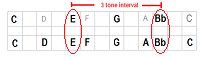
We simple use the chord notes as they are, and copy notes 9, 4 and 6 from the base scale of C
2. Change notes here and there - flatten the 6th+9th for "Spanish" scale = phrygian major
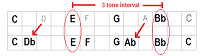
3. If you only flatten 6th - you get a second tritone! "mixolydian b6"
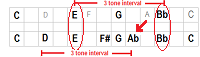
4. Same effect if to sharpen note 4 - the so called "Simpsons" scale - aka "lydian b7"
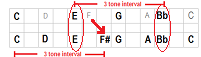
5. Abandon our 5th note and split it into b+# - we get the whole tone or 'augmented' scale
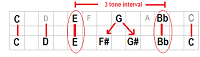
6. Flatten everything - but also
keep notes 3,5,7 we get diminished (Simon is using this a lot)
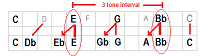
7. split 9th and 5th = the 'Altered' scale. Same tritone, altered notes.
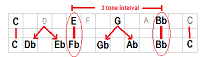
C
Alt scale can also be seen as aC tonic with all other notes in the C scale flattened! I've used 'Eb' rather than D# (same for G) to help bring this out. Also 'E' is referred to as 'Fb'

8. So far we've kept the '7' chord tritone. But Blues scale is a classic over a this chord - the tritone moves to C-F# It gets tension from those touching notes and doesn't care whether it's over a minor, or major chord!
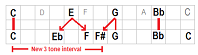
9. A classic guitar jazzer's trick is to change the chord rather than the scale. A "flat 5" substitution to F#7 has exactly the same tritone as C7. Great for bass runs, but doesn't produce much useful in the way of scales

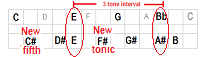
10 Finally C dorian works! Its A to Eb 3 tone interval is harmonically very weak in C, but it brings out just how close the "minor" dorian is to the "major" mixolydian in melody terms
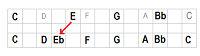
The wacky thing - sort of exemplified in the clip is that in a II-V-I or IV-V-I chord progression all of these scales work over the dominant chord. and still resolve magically back to chord I.
Thanks for reading these musings most of which come from the group in Grenoble. Apologies to those with no interest (but I did warn you at the start)


